


News
OEM Reference Parts vs Original Parts: A Buyer’s Guide for Wholesalers
For most wholesalers in Africa, South America and Southeast Asia, the real choice is rarely between a genuine part and nothing. It is between a genuine part priced above what the local market will pay and a well-made OEM-reference part that fits, lasts and can be reordered. The difference is rarely luck; it is how carefully the part was specified and checked.
What an OEM reference actually means
An OE number is an identification code, not a brand promise. It is the number the vehicle manufacturer uses on its own drawings, and it tells you which position on which model the part belongs to. An OEM-reference part is built to that specification by a supplier who is not the original manufacturer, and who publishes the OE numbers it replaces. Our own code, for example the YB series on our filters, sits next to the OE numbers in the catalogue so a buyer can cross-reference without opening a parts book.
Two rules matter in daily practice. First, one OE number is often superseded more than once, so a catalogue that lists only the latest number will look empty to a customer holding an older parts book. Second, the same OE number can cover more than one physical part when a manufacturer changes a housing mid-cycle, which is why dimensions must always be confirmed separately from the number.
Where OEM-reference parts make commercial sense
- Consumables. Filters, wiper blades and brake hardware are replaced on schedule. Customers judge them on fit and repeatability, not on the badge on the box.
- Older model coverage. Body panels, brackets and lamps for vehicles five to fifteen years old are where original supply is thinnest and price spreads are widest.
A five-point check before you approve a batch
- Dimensions, not just the number. Measure height, width and thickness of a sample against the drawing. A filter that is two millimetres too thick will not seat, and the customer will blame the whole shipment.
- Media and pleat count. On filters, count the pleats and feel the paper. Light, loosely pleated media collapses early in dusty conditions.
- Frame bonding and gasket. The urethane edge should be even, without gaps at the corners where unfiltered air leaks past.
- Electrical ratings on switches. Terminal size, pin count and connector keying must match the harness, or the part will fit the hole and fail the circuit.
- Traceability. Carton marking, batch code and one retained sample per shipment turn a complaint into a solvable case instead of an argument.
Cross-referencing without guesswork
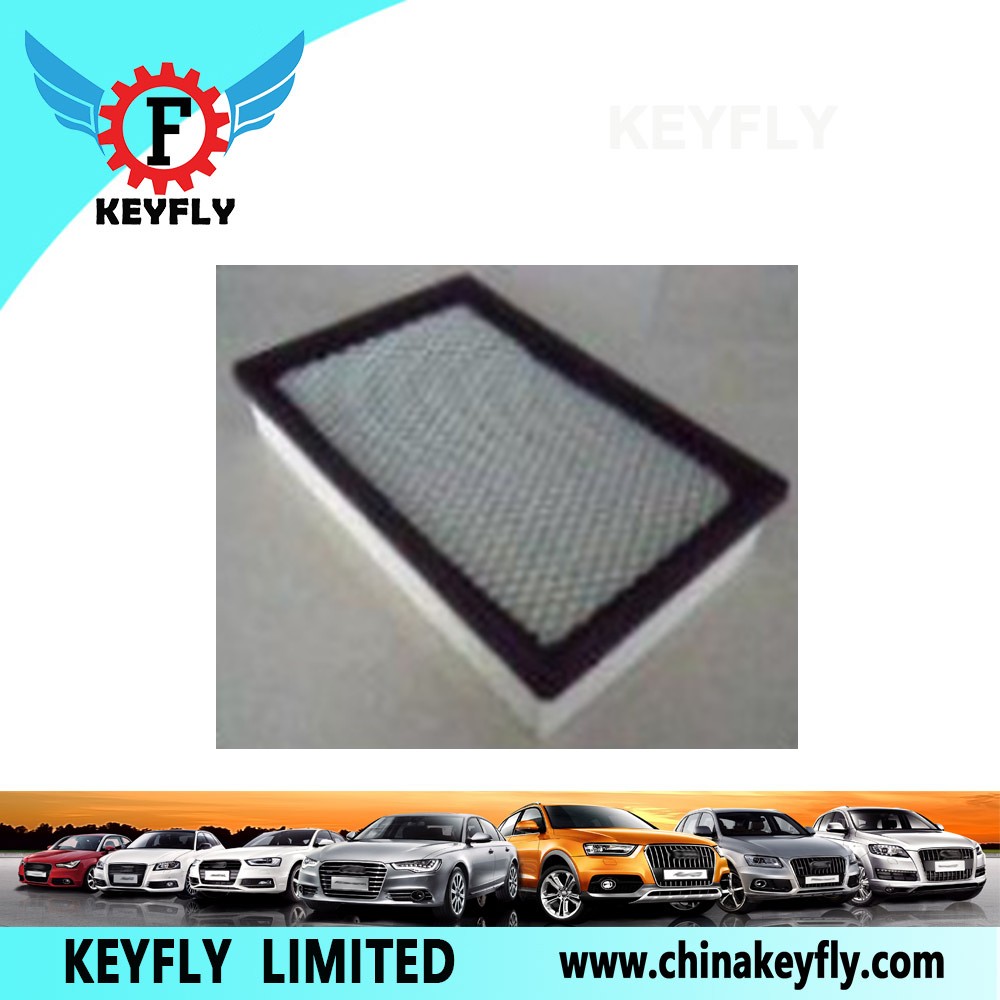
Ask any supplier for a reference table that lists OE number, superseded numbers, dimensions and vehicle applications before you discuss price. If that table does not exist, the catalogue is being managed by memory. Our CAR FILTER catalogue now carries more than 1,700 air filter references with the OE numbers shown on each product page, so a counter clerk can search by the number the customer brings in. A typical entry, the YB-901 panel filter for Ford, lists OE references E5TE9601AB and E5TZ9601B together with its dimensions of 283.5 x 190 x 48.5 mm.
The same approach applies across our other lines: car locks and ignition switches, brake slack adjusters, body parts and wiper blades. When the reference data is complete, buying aftermarket stops being a gamble and becomes a normal purchasing decision.
About KEYFLY LIMITED
KEYFLY LIMITED (www.chinakeyfly.com) is a professional exporter of automotive spare parts — air filters, car locks and ignition switches, brake slack adjusters, body parts and wiper blades — serving distributors and wholesalers in Africa, South America, and Southeast Asia. Contact: vicky@chinakeyfly.com


